


Slay the Spire: Emergent Roguelike Deckbuilding Experience

Slay the Spire is a roguelike deck-building game where the players make their way to the top, floor by floor defeating enemies, unknown encounters and challenging bosses to eventually arrive at the heart of the spire and attempt to slay it.
Being a roguelike, the game requires multiple runs to beat, making the players stronger (via unlocks) after each run and also helping the players learn more about each character’s powers, skills and relics.

The replayability of the game is commendable mainly due to the amount of builds you can have for your character depending on which cards, potions and relics you collect on your journey to the heart of the spire.
NARRATIVE:
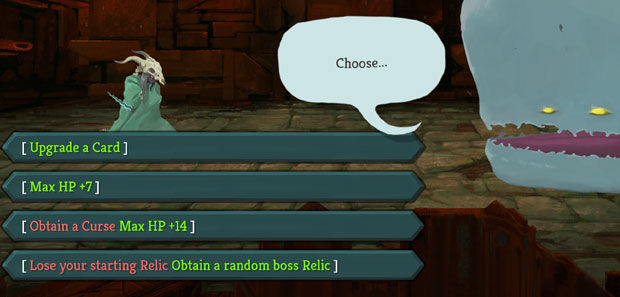
The game is not heavy on narrative. Players can choose from a small selection of characters (each with their own unique abilities, cards and an implied backstory). At the start of each run players encounter Neow, a whale-like creature who rests at the bottom of the spire blessing those who attempt a shot at the spire.
The players then attempt to climb the spire through a total of 4 Acts (Final act being blocked until player has finished the climb with the 3 characters). Players reach the heart of the spire at the end of Act 3, where they attempt to slay it but lose consciousness and faint, setting the stage for the next run.
The narrative element of the game is not very interesting. The story here is like the story in a porn video. Good to have but not what I care or focus on.
LEVEL DESIGN:
The game has 4 acts. The first 3 involve the players climbing their way to the boss chamber through a series of branching paths. Several nodes on each branch serve as the encounters in the form of:
Enemies: Standard enemies with basic rewards (card, gold, potion).
Mini-bosses: Elite enemies with better loot (relic + standard rewards).
Merchants: Purchase items or remove cards from your deck using gold.
Treasure chests: Gain relics and potions without combat.
Resting sites: Upgrade a card or rest to recover some HP.
Unknown events: Can be any of the above or special choice based events which may help or hinder the player’s run.
The branches and nodes are procedurally generated facilitating the roguelike gameplay. The procedural generation logic of the game is very well balanced and definitely one of the most fun parts of the game for me.

The mini boss fights are often near rest sites, unknown events are well sprinkled throughout each branch nudging players to take the leap of faith and it was always fun picking my most optimal route for best rewards.
MECHANICS:
The core mechanics of the combat are drag and drop to play a card using required energy (regenerates every turn). Players can do the same interaction with the potions they have collected. When out of combat, clicking to choose the next path or choice during unknown events. The mechanics are fairly simple but the game shines in the sheer variety of combinations and builds the players can deck themselves with using:
Cards: These serve as your main abilities during combat. Cards are segregated into coloured (specific to selected character) and colourless (common for all characters).
Relics: These provide passive buffs after being collected. Each character starts with their own unique relic and can collect more during the run.
Potions: One time use. Provide all sorts of boost on your turn or for the duration of the combat. Players can only carry up to 3 potions at one moment.
Among the three core elements. Cards have the most amount of variety as they can be a skill, power, attack, defence etc and even have specific conditions attached to them on how to play. This includes exhaustible cards that will get used up for the combat after play, cards which gain power the more they are used and so on.
Card types:
Attack: Deal direct damage to enemies.
Skill: Diverse effects like providing defence, buffs, debuffs etc,.
Power: A permanent upgrade for the current combat encounter.
Status: Added to deck during combat through enemies to bloat player’s deck and provide them various debuffs. Gets removed after the combat.
Curse: Permanent debuffs in the form of cards. Discussed below.
An interesting card type introduced in the game as an opposition mechanic known as Curse cards. These are shuffled into a player's deck and provide various debuffs when drawn.
GAMEPLAY:
The main part of the gameplay is combat which is turn based. Player turn followed by all enemies turn. During player turn first, 5 cards are drawn (from the draw pile) then players can play them depending on how they manage their energy (base: 3 per turn), once a card is played it's moved to the discard pile. If the player runs out of cards in the draw pile, the discard pile is shuffled and added into the draw pile. Once the player is done using all their energy, cards and (optional) potions, they click “end turn” and we move to the enemy's turn.
One cool thing to highlight here is the enemy intention that can be seen during player turn.
The players have an idea on what the enemies will do on their turn and hence can plan their cards to play accordingly. Enemies may have:
Red weapon icon with number: Will do a damage of that amount.
Shield icon: Will add block to them or another enemy.
Squiggly lines: Will use a debuff on the player character.
Fire icon: Will use a buff on them or another enemy.
??? icon: Special action.
And more...
Any of these or a mix of them is translucently televised for the players making it easier to plan and play your turn.
Out of combat, players spend time climbing the spire. We discussed that in level design. The random event nodes sometimes bring choices to the player where they may get a reward in exchange for something. These provide a fun risk versus reward situation.
STRAY THOUGHTS:
The game is indeed fun and as my first deckbuilding game I really enjoyed it. Building your deck in a number of different ways every run, finding strategies on the go and finding my best optimal route to reach the spire.



Comments